Desire Paths
Premature Optimization
Creative PracticeProduct & Experience
Before you pour the concrete, watch the grass.
Story
A new campus needs paths.
The obvious approach is to decide where people should walk, draw the routes, and pave them.
But there is another approach: wait.
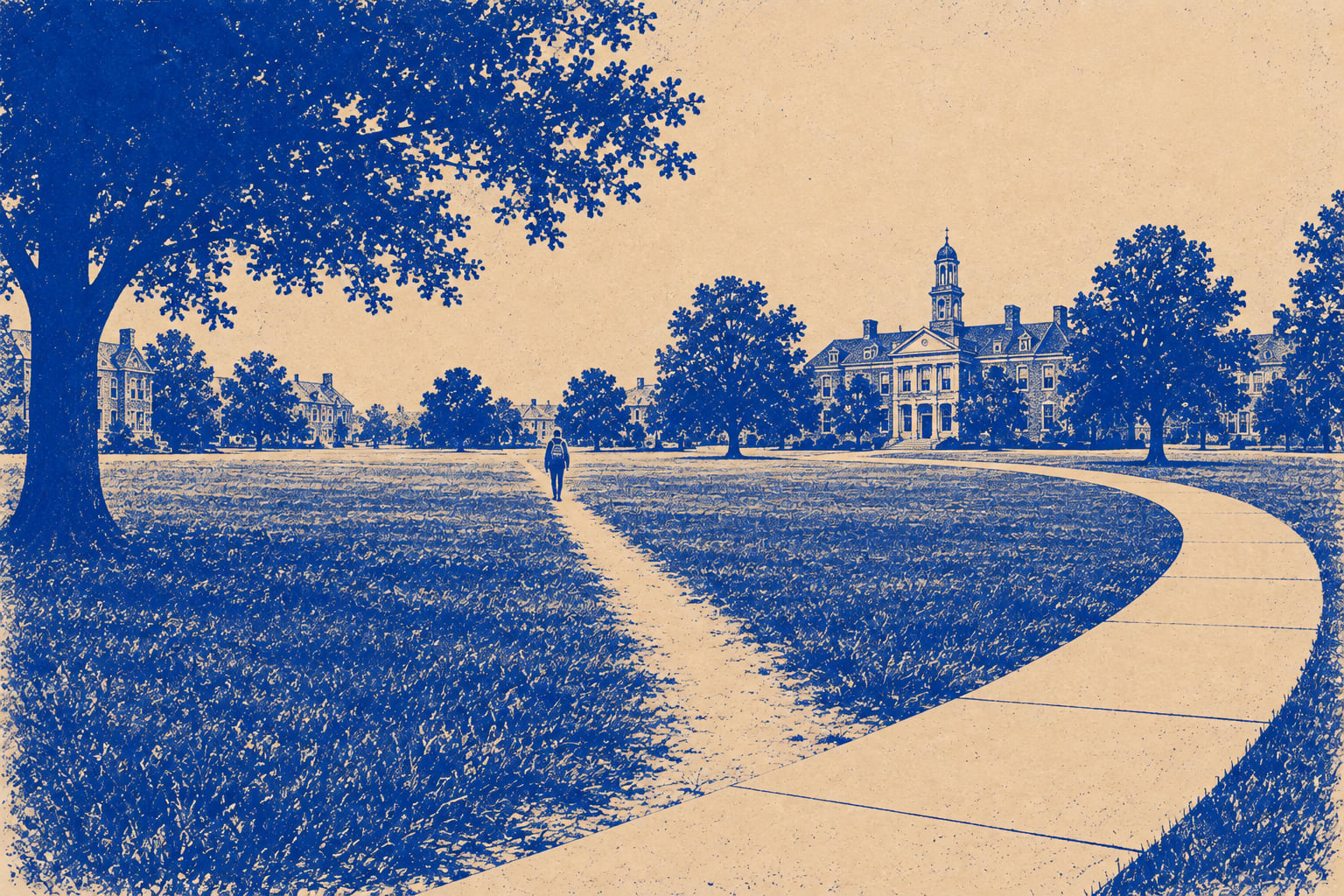
Students arrive. They move between dorms, classrooms, libraries, and parking lots. At first, the lawn is untouched. Then a faint line appears where people cut a corner. Another forms between two buildings. With enough footsteps, the grass records the routes people actually prefer.
These unofficial trails are called desire paths.
Sometimes planners respond by putting up a fence or reseeding the grass. But desire paths can also be treated as information. Instead of predicting every route in advance, some planners have deliberately waited for patterns of movement to emerge before deciding where permanent paths belong.
First the footsteps.
Then the concrete.
Elsewhere
A desire path records the difference between
planned behavior and actual behavior.
That doesn’t mean every desire path should become a sidewalk. A pedestrian may take the shortest route across terrain that isn’t suitable for a permanent path. Planners also have to account for drainage, accessibility, safety, maintenance, traffic, and environmental constraints.
But the marks in the grass provide something the original plan could not:
evidence.
Software engineering has a related idea.
Donald Knuth’s famous warning about premature optimization is often reduced to the phrase “premature optimization is the root of all evil.” His larger point was more specific: programmers can spend enormous amounts of time improving parts of a system that aren’t actually responsible for meaningful performance problems.
Optimization isn’t the problem.
Optimizing before you know what matters is.
Back to Branding
Designers like complete systems.
So before a brand has really been used, we can find ourselves designing every possible version of it: dozens of templates, elaborate component libraries, exhaustive logo configurations, rules for edge cases that haven’t happened yet.
The system looks finished.
Then the brand enters the world.
Nobody uses six of the templates. One layout gets rebuilt constantly. A logo configuration that seemed important rarely appears. Sales keeps improvising the same document. Social posts repeatedly need something the original system never anticipated.
The grass starts wearing away.
Those patterns tell you where the system deserves more attention.
This doesn’t mean avoiding systems or refusing to anticipate obvious needs. It means recognizing the difference between necessary structure and speculative optimization.
Build what you need to start using the brand well.
Then let use show you what deserves to become permanent.
The Principle
Some things should be designed in advance.
Others become clearer through use.
When behavior is still uncertain, making every decision permanent can mean investing time and resources in assumptions that reality will soon correct.
Build enough structure to begin.
Then observe where the pressure actually appears.
Don’t perfect the path before you know where people walk.
Put It to Work
Look at the last several things your brand actually produced.
Find something that was repeatedly modified, recreated, worked around, or improvised.
That’s a path forming.
Build there.
Reflection
Where is the grass wearing thin?